
Introduction
Would you like to break new ground? If your response is “YES” – keep reading!
Today, AI is reshaping how we understand, detect, and manage ADHD — turning insight into action and treatment into daily empowerment. While medication still plays a key role, it often fails to solve real-life struggles like organization, focus, and emotional balance.
We would like to admit that ADHD is about much more than distraction or impulsivity — it’s a complex neurodevelopmental condition that shapes how individuals process information, regulate emotions, and engage with their surroundings. It affects motivation, working memory, and reward sensitivity, often creating a mismatch between intention and action. Understanding ADHD through this broader lens helps us see that its challenges aren’t signs of laziness or lack of discipline, but reflections of how the ADHD brain operates in real time. This perspective is essential for designing AI systems that don’t just correct behavior, but truly resonate with how neurodiverse minds think, learn, and thrive.
That’s where AI-powered ADHD management steps in — bridging the gap between clinical results and everyday functionality. Through data, behavioral modeling, and adaptive feedback, these systems offer 24/7 personalized support that grows with each user.
If your company operates in mental health and wants to build scalable, evidence-based solutions, AI-driven ADHD care is your next growth frontier.
Despite decades of research and effective medications, millions still face daily dysfunctions ADHD pills can’t fix — creating a growing demand for intelligent, personalized digital tools that support real-world change.
At Amazinum, we frequently hear questions from clients about how AI can improve ADHD care beyond medication. This article summarizes what we’ve observed in the field, the challenges that remain, and practical solutions that have already shown results.

Key ADHD Management Challenges We See
From our work with clients and analysis of existing ADHD tools, we see four recurring challenges that limit their real-world effectiveness. Understanding these gaps is the first step toward meaningful AI solutions.
Limitations of Medication Alone
Medications reduce hyperactivity and impulsivity, yet many users continue to struggle with executive functions such as planning, time management, and emotional regulation. Behavioral inertia, attention crashes during medication wear-off, and co-occurring conditions like anxiety or depression remain largely unaddressed.
Engagement and Motivation Gaps
Even well-designed digital tools often fail to keep users engaged over the long term. Without gamified experiences, personalized prompts, or adaptive feedback, adherence drops, and benefits are short-lived.
Insufficient Personalization for Diverse ADHD Profiles
ADHD is highly heterogeneous. Most apps treat users the same way, ignoring differences in attention patterns, emotional states, and environmental context, which reduces effectiveness.
Privacy, Compliance, and Ethical Concerns
Collecting behavioral and physiological data raises critical issues around security, consent, and bias. Narrow datasets may not generalize across populations, and current tools often lack robust privacy frameworks.
Where AI Can Make a Real Difference
AI offers solutions that extend beyond symptom suppression to meaningful daily support, but real-world deployment still faces challenges. Based on our experience at Amazinum, we observe that thoughtful AI integration can address each problem area:
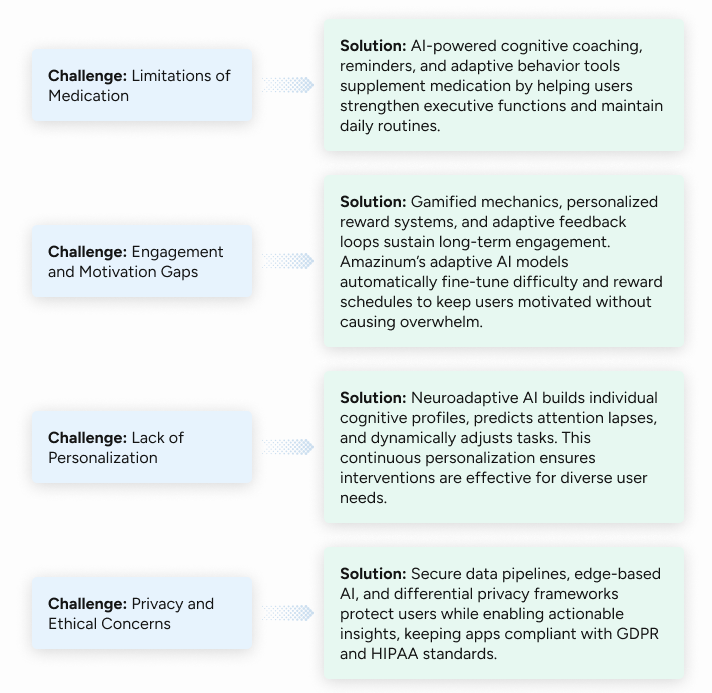
These four challenges—limited impact of medication, engagement drop-off, lack of personalization, and persistent privacy concerns—represent the key barriers to effective ADHD management today. Addressing them holistically requires moving beyond symptom control toward systems that are adaptive, ethical, and deeply personalized. Recognizing these gaps lays the foundation for building AI-driven tools that deliver meaningful, sustainable support in the real world.
What’s Next?
In our upcoming article, we’ll dive deep into how leading ADHD apps are leveraging AI — from cognitive training and emotional detection to personalized coaching that adapts in real time. You’ll discover what truly sets successful solutions apart, which technical challenges developers face, and how AI can become your strategic co-pilot in building neuroadaptive, human-centered products.
We’ll unpack 10 key features that define the top ADHD apps, explore how wearables and adaptive algorithms create smarter engagement loops, and reveal how Amazinum turns clinical insights into real-world, AI-driven outcomes.
Get ready for a behind-the-scenes look at the future of digital ADHD care — where technology meets empathy, and innovation goes far beyond medication.
Stay tuned — the next chapter with You, AI, and Amazinum is just around the corner.