
The Rise of AI-Native Marketing Products
Over the past few years, AI has become nearly universal in marketing products. Large platforms, mid-sized tools, and even small niche applications all claim to use artificial intelligence in some form. Yet their results differ dramatically. Some continue to scale and compound their advantage, while others struggle to translate AI adoption into meaningful growth.
In this article, we explore how leading martech companies build AI into the core of their products, why AI-native platforms set a higher bar for effectiveness, and what other teams can learn from the way these systems are designed and operated.
What Does “AI-Native” Actually Mean?
An AI-native product is not a traditional SaaS platform enhanced with machine learning features. It is a system where AI defines the architecture, decision logic, and core user workflows.
In AI-native products:
- AI drives primary decisions, not just recommendations
- Core workflows cannot function without algorithmic intelligence
- The system continuously learns from behavioral feedback loops
- Data pipelines are designed to fuel models in real time
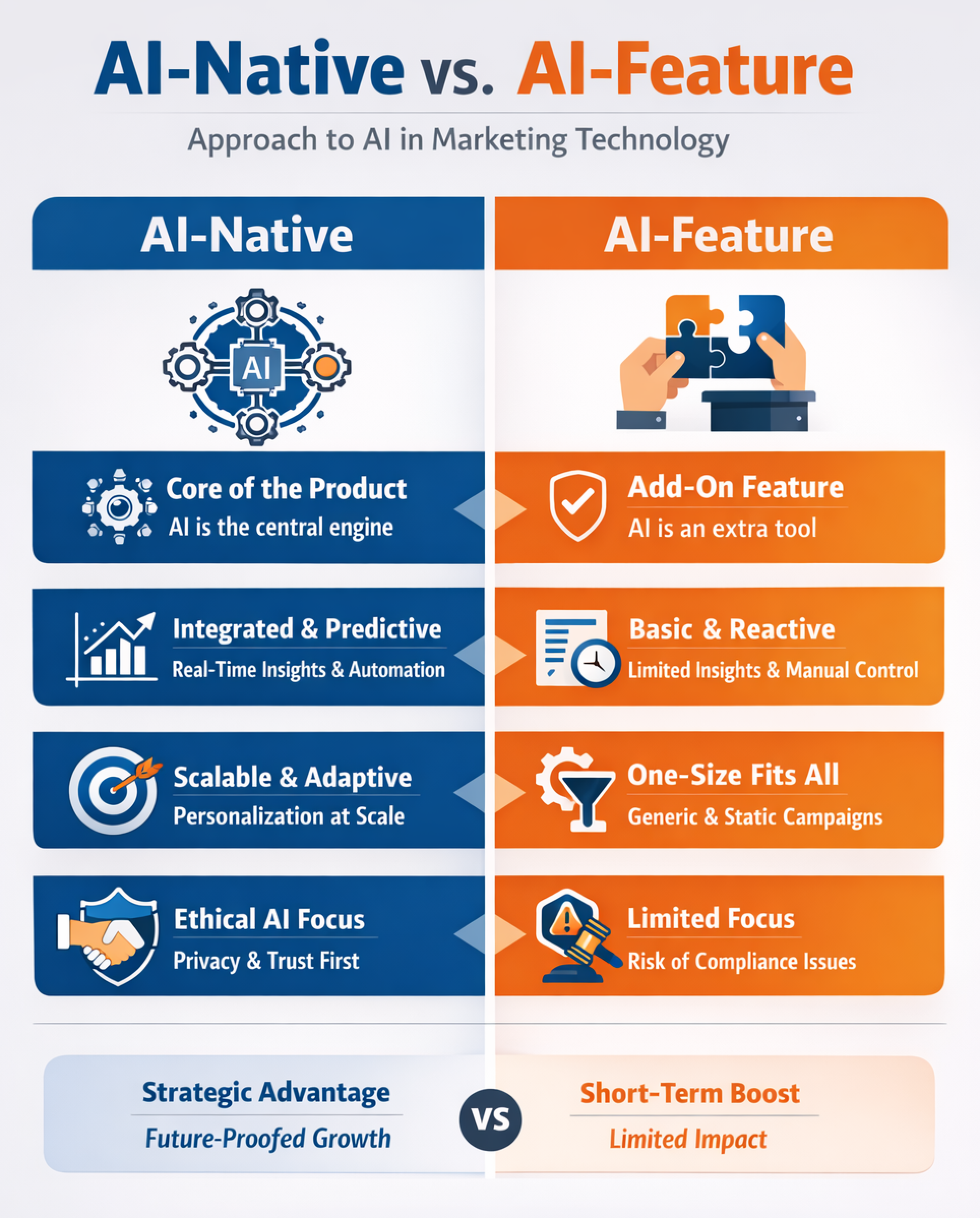


Embedding AI at the Core
The most successful Martech companies in the world don’t consider AI as a flashy, superficial feature- they build it in at the core of their products, making it the engine that empowers every marketing decision. From customer segmentation and predictive analytics to dynamic content optimization, AI becomes the lens through which marketing teams understand audiences, anticipate behavior, and deliver personalized experiences at scale.
Using AI to make decisions, these platforms help marketers work faster and more accurately. AI can instantly analyze vast volumes of customer interactions to identify high-value prospects or predict campaign performance capabilities that would otherwise take human teams weeks or even months.
However, embedding AI goes beyond technical execution. Leading companies recognize that responsible AI usage is essential for trust, transparency, and compliance. By prioritizing ethical practices and aligning automated decisions with brand values and customer privacy, they turn AI into a true strategic advantage-one that raises the standard for marketing effectiveness, performance, and growth.
Across leading platforms, AI-native design follows a consistent architectural pattern:
- Data Infrastructure Layer
Real-time behavioral, transactional, and contextual data pipelines. - Model Layer
Machine learning models, predictive systems, and increasingly LLM-based reasoning engines. - Decision Engine
Real-time scoring, prioritization, bid allocation, content selection, and audience segmentation. - Activation Layer
Automated execution across ads, personalization engines, messaging systems, and content generation. - Feedback Loop
Continuous model retraining based on performance signals and user interaction data
This architecture transforms marketing software from a reporting interface into an autonomous optimization system.

Examples from the World’s Marketing Giants
The shift from “AI-powered features” to AI-native products is most evident in the strategies of global martech leaders. For these companies, AI is not an add-on – it is the operational core orchestrating targeting, personalization, creative production, experimentation, and measurement in real time.
Google: AI as the Invisible Operating System of Marketing
At Google, AI underpins the entire advertising and analytics ecosystem.
In Google Search, machine learning models interpret user intent and context at scale, transforming search from keyword matching into intent prediction.
Within Google Ads, especially Performance Max, AI automates bidding, targeting, placements, and creative optimization across channels. Marketers set objectives and provide assets; AI dynamically allocates budgets and selects formats to maximize results.
Google Analytics 4 integrates predictive metrics such as churn probability and purchase likelihood, shifting analytics from reporting to forecasting. Meanwhile, Google Ads Creative Studio streamlines scalable creative production and personalization.
Meta: AI-Driven Advertising at Massive Scale
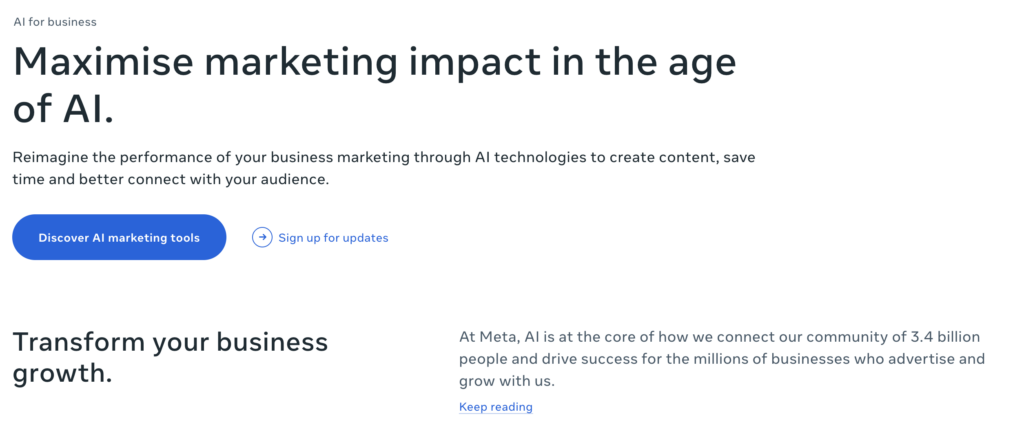
Source: Screenshot from Meta, accessed March 2026
Meta is still widely perceived as “Facebook” – a social network. But from a product perspective, it is one of the most influential marketing technology platforms in the world. Its advertising infrastructure powers millions of campaigns globally, making it a critical case study in how AI reshapes marketing systems at scale.
While Meta invests in AI across many domains, its recent direction is especially visible in advertising. The company has publicly outlined its ambition to move toward increasingly AI-driven ad creation, targeting, and optimization – often described as a shift toward fully AI-managed advertising workflows by 2026. In this model, advertisers define business objectives, budgets, and constraints, while AI systems handle audience selection, creative assembly, delivery optimization, and performance learning.
SEMrush: AI and LLMs Transforming SEO
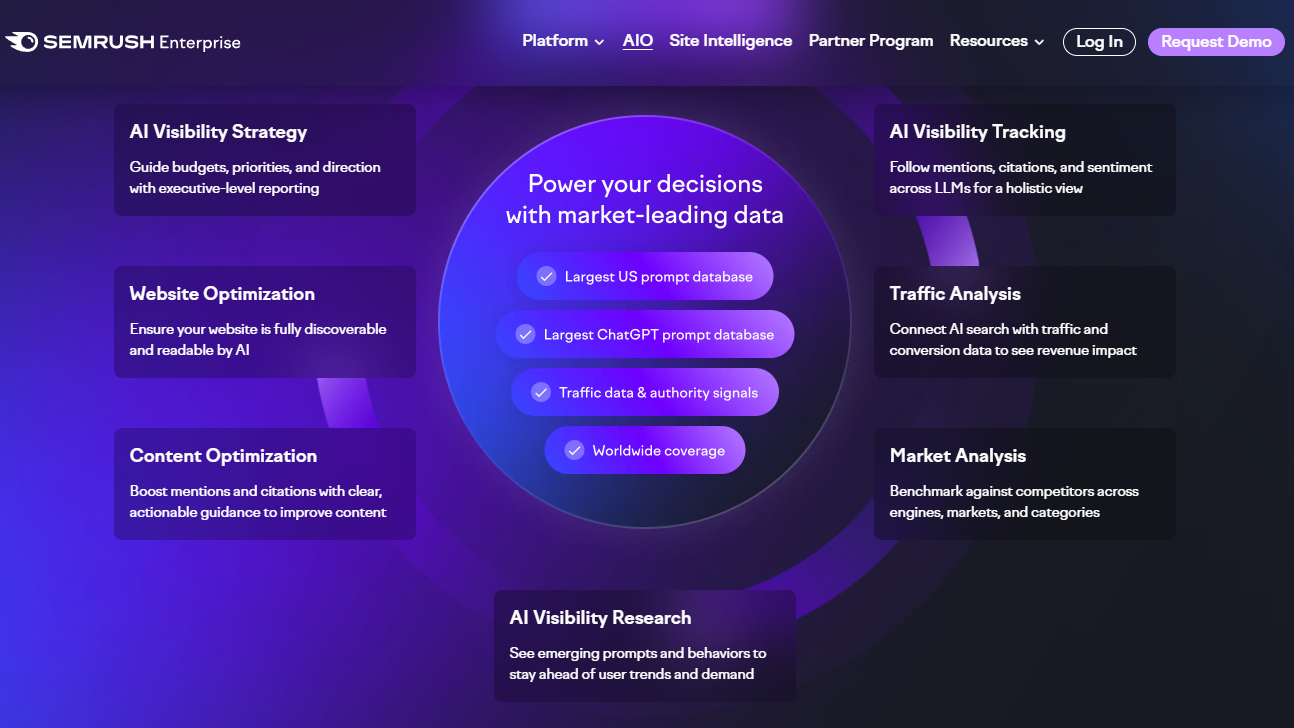
Source: Screenshot from Semrush, accessed March 2026
SEO platforms increasingly embed large language models into their core tools. SEMrush applies AI to automate keyword clustering, SERP intent analysis, and content optimization recommendations. SEO is moving beyond keyword density toward semantic coverage, entity relationships, and topic authority modeling.
In 2025, SEMrush further expanded this direction with the launch of Semrush Enterprise AIO, an enterprise-level solution explicitly designed for AI-driven search environments. As reflected in its name (AI Optimization), the platform enables large brands to monitor and improve their visibility across LLM-powered systems such as ChatGPT and emerging AI-based search experiences. Enterprise AIO tracks how brands appear in AI-generated responses, analyzes competitive representation, evaluates positioning and sentiment, and provides strategic recommendations to strengthen visibility within generative answer ecosystems. Rather than focusing solely on traditional SERPs, this product addresses optimization for AI-generated outputs – signaling a structural shift from classic SEO toward AI visibility management at the enterprise level.
A comparable transformation is visible in applied LLM-based SEO solutions solutions implemented at Amazinum, where AI supports automated content structuring, intent mapping, and scalable content workflows. In a recent project, we extended this approach by building an LLM-driven SEO system designed to analyze how generative AI systems interpret, prioritize, and reference brand content within AI-generated responses.
The methodological foundation of this approach – particularly the shift toward entities, contextual signals, and semantic relationships instead of isolated keywords – is detailed in the article “NLP for SEO: The Shaping of a New Marketing Landscape.”
Ahrefs: Data Intelligence Meets Machine Learning
Ahrefs complements its large-scale backlink and keyword databases with AI-driven ranking, difficulty scoring, content gap detection, and intent classification. Rather than offering raw metrics alone, AI layers interpret competitive patterns and search behavior, turning data into strategic recommendations. SEO tools evolve from dashboards into intelligent guidance systems.
By integrating machine learning models, Ahrefs can predict trends in keyword performance and backlink value, helping marketers prioritize efforts with higher ROI potential. Its AI-driven content suggestions go beyond simple keyword density, analyzing user intent, topical relevance, and semantic context to craft strategies that align with both search engines and audience behavior. This shift transforms SEO from reactive analysis into proactive, data-informed decision-making, empowering teams to anticipate changes in search dynamics before they impact rankings.
Optimizely: AI-Driven Experimentation and Content Generation
Optimizely embeds AI into experimentation and content workflows, accelerating testing cycles and enabling dynamic personalization. Beyond traditional A/B testing, AI identifies high-potential audience segments and adapts digital experiences in real time.
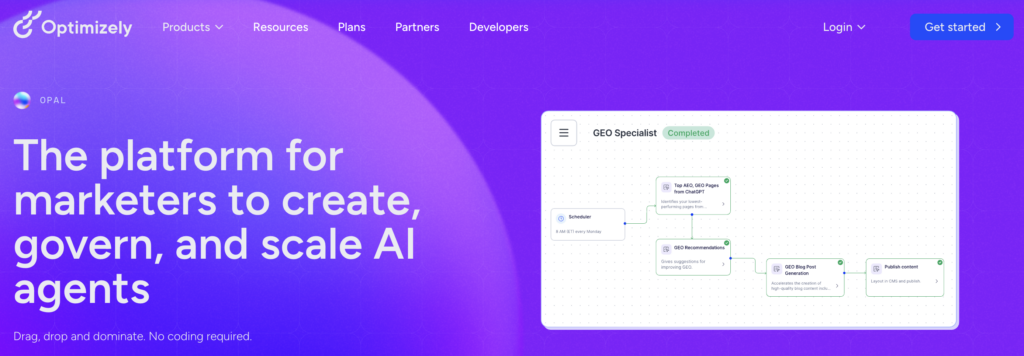
Source: Screenshot from Optimizely, accessed March 2026
The company has expanded its AI direction toward generative content systems and marketing-focused AI agents. These systems assist marketers in producing optimized content variations aligned with performance goals, automating experimentation logic, and enabling scalable personalization across digital touchpoints. As described in their insights publication “How We Use AI at Optimizely”, AI is increasingly embedded into operational marketing processes rather than functioning as a standalone feature.
In one of our projects, we built an LLM-based system for generating structured marketing campaign assets, designed to automate the creation of content variations aligned with brand tone, campaign objectives, and performance requirements.
Related: LLM System for Creating Assets for Marketing Campaign
Amplitude: Predictive Product and Behavioral Analytics
Amplitude integrates machine learning into product analytics to predict churn, detect high-value segments, and recommend next-best actions.
This moves teams from descriptive reporting to prescriptive decision-making, enabling continuous optimization across the customer lifecycle.
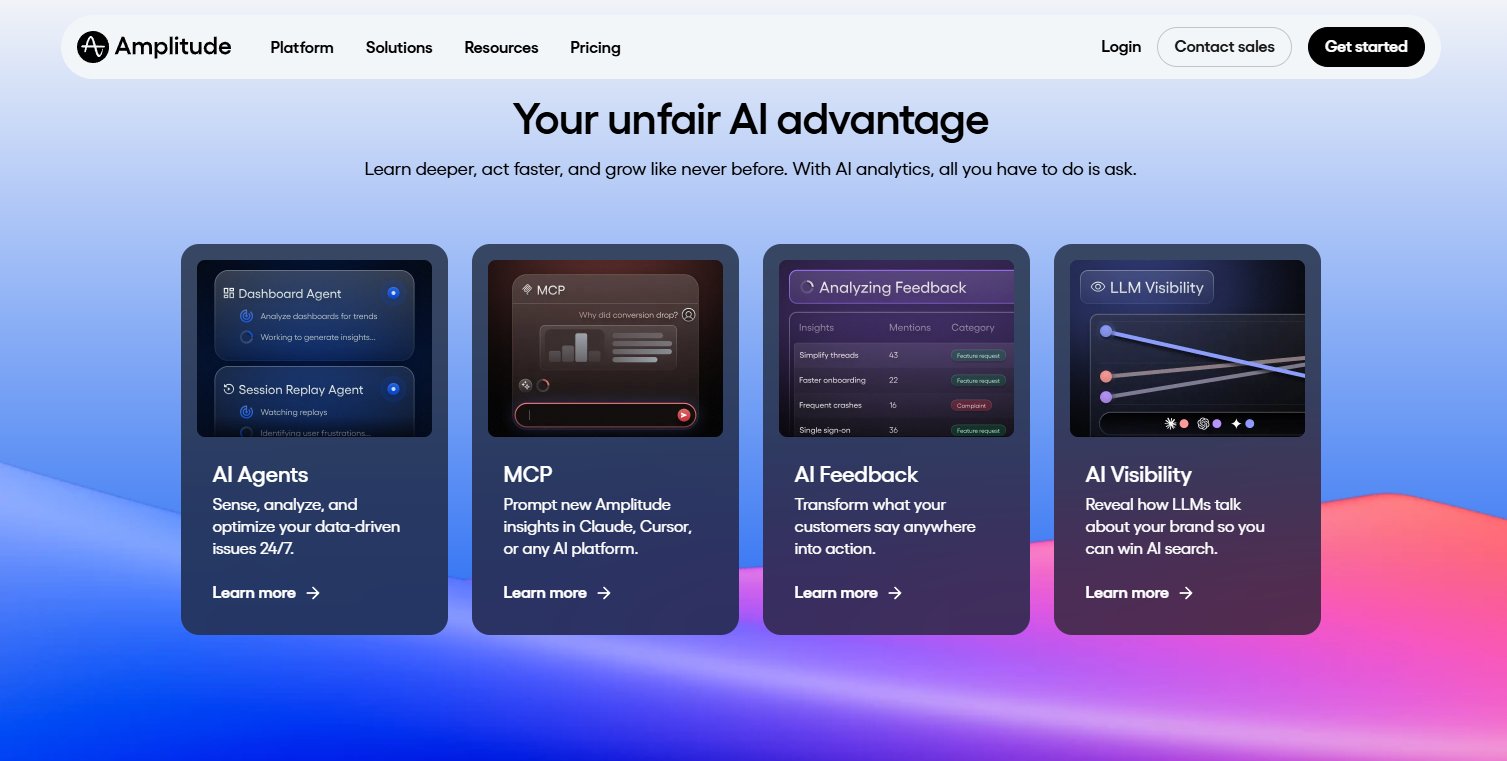
Source: Screenshot from Amplitude website, accessed March 2026
On Amplitude’s website, AI is not presented as a background enhancement inside traditional analytics dashboards. It is structured as a distinct product layer – with clearly defined components such as AI Agents, AI Feedback, and AI Visibility.
This structure changes how analytics is experienced. Instead of manually navigating reports, teams can rely on AI Agents to execute complex analyses, investigate root causes, build dashboards, and surface recommended actions. AI Feedback processes customer input at scale to identify bugs and product opportunities, while AI Visibility helps brands understand how they appear across LLM-powered search tools. Through MCP, behavioral context can also be brought into external AI environments.
Synthesia: Generative AI for Scalable Video Content
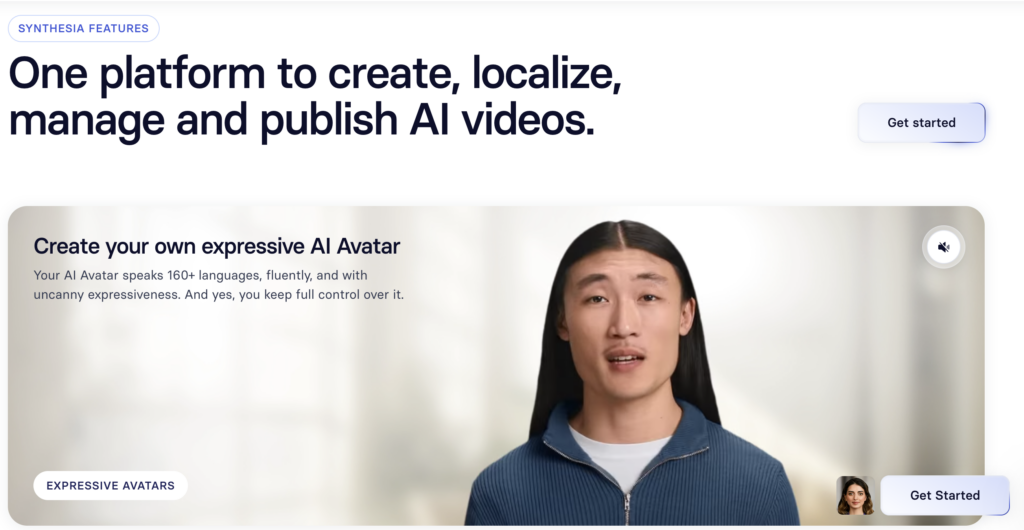
Source: Screenshot from Synthesia, accessed March 2026
Synthesia leverages AI-generated avatars and voice synthesis to produce personalized video content without the constraints of traditional filming. Marketing teams can now create dynamic, localized videos at scale, reducing production costs and timelines while delivering highly tailored experiences for diverse audiences.
What sets Synthesia apart is how it turns video from a static deliverable into a living, adaptive channel. Campaigns can evolve in real time: messaging can be updated instantly, new audience segments can be reached without re-shoots, and every viewer can feel that the content was created specifically for them. By embedding AI at the core of video creation, Synthesia transforms what was once a resource-intensive process into an agile, data-driven engine for engagement and personalization, demonstrating the power of AI-native design in modern marketing workflows.
Mid-Sized Companies: AI Embedded in Core Workflows
If global giants demonstrate how AI becomes infrastructure, mid-sized companies show that AI-native execution is achievable without trillion-dollar ecosystems. The key lesson is not scale – it is architectural intent. AI must be embedded directly into the core product workflow, not added as a marketing feature.
Knorex: AI as the Campaign Engine
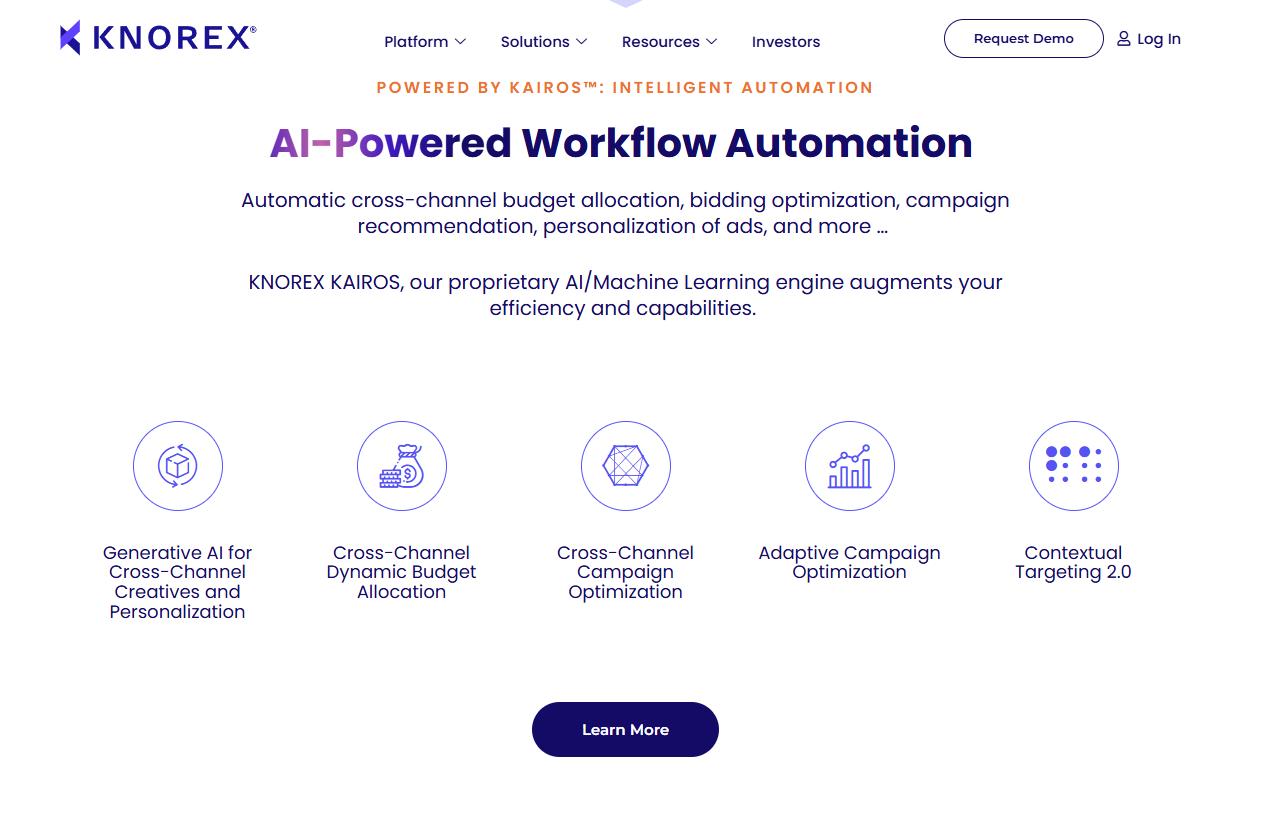
Source: Screenshot from Knorex, accessed March 2026
Knorex shows how a mid-sized MarTech platform can build AI into the heart of advertising execution. Its programmatic infrastructure uses machine learning for media buying, audience targeting, bid optimization, and cross-channel orchestration. Instead of offering manual configuration tools with optional automation, Knorex positions AI as the campaign engine itself. Marketers define objectives and performance constraints; the system continuously optimizes delivery in real time. By embedding AI directly into execution layers, especially in performance marketing, mid-sized companies can compete effectively, delivering measurable ROI without massive infrastructure.
Attentive: AI in Lifecycle Revenue Optimization
Attentive demonstrates how AI strengthens lifecycle and retention marketing. Through predictive segmentation, send-time optimization, and behavioral triggers, the platform enhances engagement across SMS and owned channels. The result is not just automation – it is revenue intelligence applied to customer communication. AI continuously refines timing, messaging relevance, and audience prioritization, allowing mid-sized companies to drive measurable gains in retention and lifetime value without massive media budgets.
For more practical examples and ideas on AI in mid-sized MarTech, explore marketing industry insights.
AI as a Core Growth Engine: Impact Metrics and Common Patterns
Across leading Martech platforms, AI consistently delivers measurable business impact: higher conversion rates through predictive targeting, lower customer acquisition costs via automated bidding, faster experimentation cycles, and improved retention driven by behavioral forecasting. Generative AI tools further accelerate content creation and deployment, reducing operational friction while increasing personalization at scale.
At the same time, a clear pattern emerges among marketing technology leaders: AI is not treated as an add-on feature – it is embedded as the core product capability. At Google, machine learning shapes every advertising decision and anticipates user intent. At Synthesia, generative AI enables scalable, personalized video production. In both cases, data functions as an intelligent pipeline, transforming raw inputs into real-time insights while allowing human teams to focus on strategy, brand alignment, and ethical governance.
End-to-end integration is the defining factor. AI connects insights, predictions, and actions across channels, enabling campaigns to adapt dynamically rather than reactively. When supported by built-in transparency, privacy safeguards, and alignment with brand values, ethical AI shifts from being a potential risk to becoming a sustainable competitive advantage.
Ultimately, these examples demonstrate that AI creates a lasting impact only when embedded architecturally across workflows and customer experiences. Success depends less on company size and more on strategic intent – proving that even mid-sized organizations can achieve enterprise-level results by making AI foundational rather than optional.
Three Signals That a Martech Product Is Truly AI-Native
Not every platform claiming AI integration qualifies as AI-native. Three structural signals distinguish true AI-native systems:
- AI Executes Decisions, Not Just Insights
The system autonomously allocates budgets, prioritizes audiences, or generates content variations. - Learning Is Continuous and Compounding
Each interaction strengthens the system, creating a data flywheel that compounds competitive advantage over time. - Workflows Are Algorithmically Dependent
Core product functionality would collapse without predictive or generative intelligence.
When these three signals are present, AI shifts from enhancement to infrastructure.
Conclusion: AI as a Foundation, Not a Feature
The message is simple: embedding AI at the core of products is no longer optional-it’s a differentiator. AI-native systems empower real-time decisions, personalized experiences, and sustainable growth, while ethical use builds trust and long-term value.
For every marketer and product leader, the question is clear: “Is AI central to our product, or just an add-on?” Start small, embed intelligence into workflows and experimentation, and scale deliberately. The sooner AI becomes the foundation, the sooner your organization can unlock its full potential for growth, efficiency, and lasting competitive advantage.